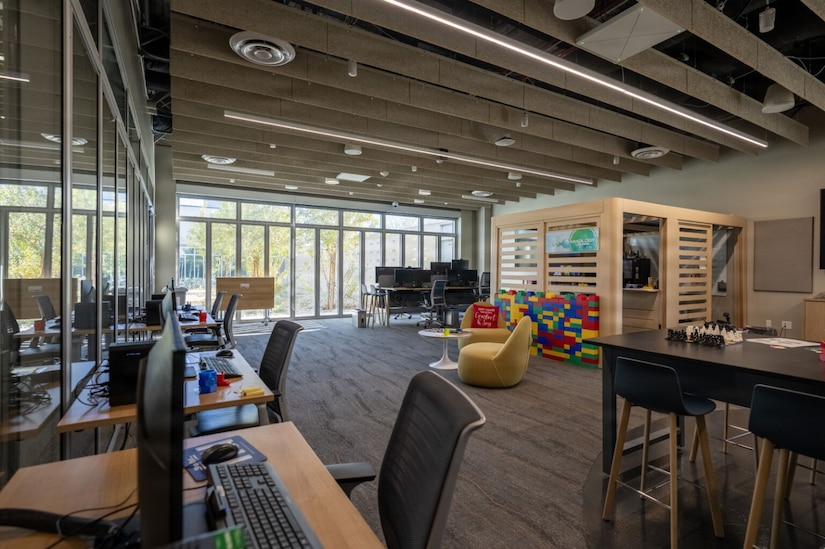
The Innovation Lab is a Naval Air Warfare Center Weapons Division makerspace at Naval Air Weapons Station China Lake (with a twin lab at Naval Air Station Point Mugu) that gives sailors, civilian employees and industry partners a shared workshop to quickly turn ideas into hardware for Navy missions. It offers a collaborative space plus rapid‑prototyping tools such as 3D printers, laser cutters, computer‑numerical‑control (CNC) machines, 3D‑scanning capability and design workstations, along with training so users can design, build and test parts in days instead of relying on outside contractors.
Naval Air Weapons Station (NAWS) China Lake is a large U.S. Navy installation in the western Mojave Desert of California, about 150 miles (240 km) north of Los Angeles, near the city of Ridgecrest and spanning Kern, San Bernardino and Inyo counties. Its primary mission is to support the Navy’s research, development, testing and evaluation of weapons and other aviation systems, making it the Navy’s largest single landholding for weapons and armaments R&D, acquisition, testing and evaluation.
Vincent Malpaya is a mechanical engineer at the Naval Air Warfare Center Weapons Division. In the Innovation Lab story, he is shown using the lab’s tools to design and fabricate hardware such as a low‑cost switch matrix for rocket testing and a 3D‑printed gimbal mount for a weapons system, helping keep test projects on schedule while greatly reducing cost.
The lab typically tackles practical, urgent engineering problems that affect fleet testing and operations, especially when standard contracting would be too slow or expensive. Examples in the article include building a switch matrix for rocket testing, designing and printing a gimbal mount for a weapons system, and creating an accurate mounting plate to install new equipment on a KC‑130 aircraft when vendor drawings were incomplete or incorrect—along with similar custom fixtures, brackets and test hardware.
The lab shortens development timelines by doing rapid prototyping in‑house instead of sending designs to outside machine shops, which would require contracting, manufacturing and shipping lead time. Engineers can 3D‑scan existing equipment, design parts on computers, and quickly cut or 3D‑print prototypes with the lab’s printers, laser cutters and CNC machines, then iteratively test and adjust low‑cost mock‑ups (for example, in plywood) until they fit, turning what might be months of external work into a few days on site. Having identical Innovation Labs at both China Lake and Point Mugu also lets teams share access to equipment and avoid delays.
According to the article, solutions developed in the Innovation Lab are built and tested quickly by the engineers and range teams who need them, which keeps test events on schedule and helps new capability reach the fleet faster. The story does not explain the formal approval chain for fielding; in practice, any hardware that becomes an operational capability for warfighters would go through the Navy’s normal safety, test and acquisition processes, so final decisions to field such solutions rest with the relevant program offices and command leadership rather than the lab itself.