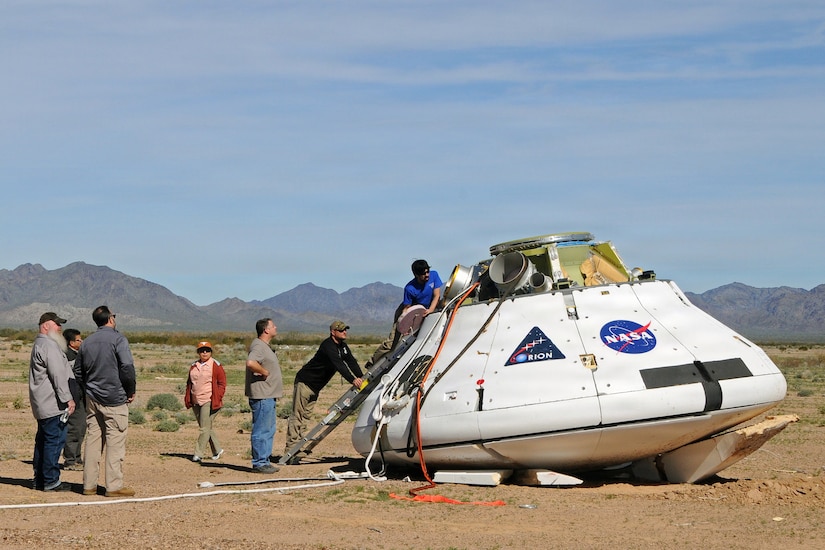
YPG conducted multiple developmental and qualification tests of Orion’s Capsule Parachute Assembly System (CPAS) (2011–2018), including instrumented airdrops over land for easier recovery and analysis; testing led to design changes such as replacing steel suspension cord with Kevlar and validated redundancy scenarios (e.g., intentionally disabling chutes) used to certify the system that will slow and land Orion on return from lunar missions.
Yuma Proving Ground (YPG) is a U.S. Army test installation that is part of the U.S. Army Test and Evaluation Command (ATEC); it operates the Yuma Test Center and manages multiple region test centers and ranges, and is run by the U.S. Army (garrison headquarters and civilian workforce on site).
Artemis II is NASA’s first crewed lunar flyby test: a roughly 10‑day mission that will launch atop SLS with four astronauts in Orion, perform a translunar trajectory to fly around and past the Moon, conduct crewed systems verification and science/biomed investigations, then return to Earth for atmospheric re‑entry and parachute‑assisted splashdown/recovery.
“Opportune launch window” here means the timeframe when Earth–Moon geometry, mission trajectory, vehicle readiness and ground‑system support align to permit safe translunar injection and mission timing; NASA set the practical window from early February through the end of April 2026 to match those flight‑dynamics and operational constraints for Artemis II.
The four assigned Artemis II crew are NASA astronauts Reid Wiseman, Victor Glover and Christina Koch, plus Jeremy Hansen from the Canadian Space Agency (CSA).
Yes. The Department of Defense supports Artemis missions through range, tracking, recovery and test support roles (e.g., Navy/other services support recovery and range safety, and DoD test ranges such as YPG provide hardware testing and qualification); NASA coordinates operational support with DoD components but NASA leads mission execution.
YPG’s Artemis‑related work brings economic and operational impacts locally: YPG is Yuma County’s largest civilian employer (over ~2,000 civilian personnel) and the installation contributes >$1.1 billion annually to the regional economy; continued NASA testing increases steady jobs, technical work and visibility while adding scheduled test/recovery activities that the installation plans for as part of its normal operations.