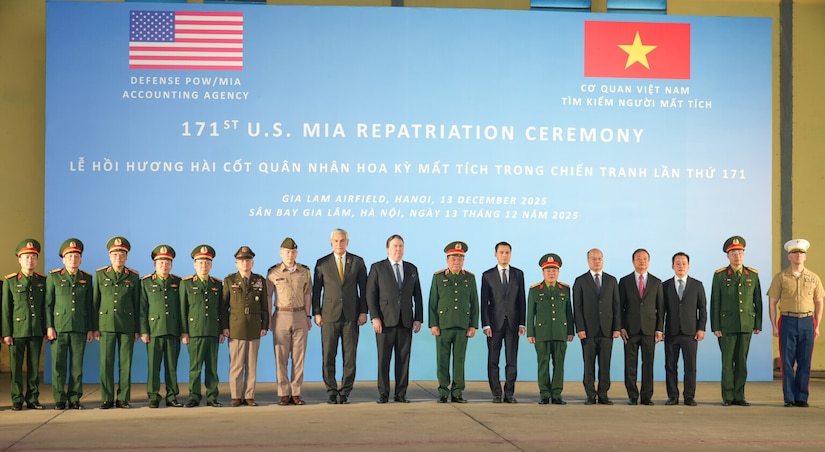
The Defense POW/MIA Accounting Agency (DPAA) is a U.S. Department of Defense agency whose mission is to find, recover, and identify U.S. military personnel who are still unaccounted for from past conflicts, and return their remains to their families. It conducts historical research, field investigations and excavations worldwide, and laboratory analyses to provide the “fullest possible accounting” to families and the nation.
In a repatriation ceremony, U.S. and host‑nation officials formally hand over recovered remains to U.S. custody. The remains, placed in a transfer case that is often draped with a U.S. flag, are escorted by a military honor guard while both sides give remarks, sign transfer documents, and render salutes; afterward the remains are loaded onto a U.S. aircraft and flown to a DPAA laboratory for identification work.
In this context, “possible remains” means material that forensic experts believe is likely human and may belong to a missing U.S. service member, but which has not yet been scientifically confirmed or individually identified. For the 171st ceremony, U.S. and Vietnamese forensic specialists first examined what Vietnam recovered and concluded the remains might belong to a U.S. service member from a specific crash site, so they were handed over to DPAA for full laboratory analysis.
Gia Lam Airfield (Gia Lam Airport) is a military airfield in Long Biên District on the eastern bank of the Red River in Hanoi, Vietnam. It has historic importance as the site where U.S. prisoners of war were first flown home in 1973 and is a secure, military‑controlled field in the capital, so it is used as a practical and symbolic location for modern joint U.S.–Vietnam repatriation ceremonies such as the 171st event.
After a ceremony, DPAA transports the remains to its accredited laboratory (for Vietnam War cases, typically the Daniel K. Inouye DPAA Center of Excellence in Honolulu). There, scientists clean and inventory the remains, study the bones (age, sex, stature, trauma), compare dental records and X‑rays, and take bone or tooth samples for DNA testing at the Armed Forces DNA Identification Laboratory; these results are compared with historical records and DNA reference samples from families to reach a scientifically supported identification. The time required depends on how complete and degraded the remains are and what records exist; individual IDs often take many months and can take years, so there is no fixed timeline.
Repatriation work between the United States and Vietnam is mainly coordinated by the Defense POW/MIA Accounting Agency (DPAA) on the U.S. side and the Vietnam Office for Seeking Missing Persons (VNOSMP) on the Vietnamese side. These partners plan and carry out Joint Field Activities and Vietnamese unilateral recovery missions and then jointly preside over formal handover ceremonies, such as the 171st repatriation at Gia Lam Airfield.